Subject: Technical Specification of the 10-KPI Scoring Matrix
Scope: Global Simulation Standard (Validated over 100,000+ Game Sessions)
Version: 2.3 (2024)
1. Executive Summary
The MonsoonSIM scoring engine utilizes a Unity Normalized Scheme to evaluate team performance up to ten distinct Key Performance Indicators (KPIs). This system is designed to provide a multi-dimensional, objective, and competitive ranking that reflects real-world business dynamics. Unlike static grading, this methodology focuses on Relative Performance Evaluation (RPE), ensuring that success is measured against the shifting benchmarks of a live market.
2. The Philosophy of Relative Strength
In a dynamic economy, "Absolute Strength" (raw numbers) is often misleading due to market volatility. MonsoonSIM prioritizes Relative Strength, comparing each team’s performance against its peers within the same simulation environment.
Market-Neutrality: Whether the game environment is high-growth or recessionary, the system remains fair by rewarding the teams that optimize their strategy best relative to current conditions.
The Benchmark Principle: The top-performing team in any specific KPI sets the "gold standard" (1.0) for that category, while others are mapped based on their distance from that leader.
3. The Unity Normalization Algorithm
To aggregate KPIs with varying units (e.g., Currency, Percentages, Days, and Ratios), the system converts all raw data into a Unity Scale (0.15 to 1.0).
A. Directional Logic
The algorithm applies one of three logic models based on the KPI's nature:
Higher is Better (MAX): Used for Profit, Market Share, etc. The highest raw value is assigned the 1.0 score.
Lower is Better (MIN): Used for Operating Expenses, Stock-outs, etc. The lowest raw value is assigned the 1.0 score.
Closest to Target (TARGET): Used for Area Utilization (100%) or Days of Inventory. The value with the smallest absolute deviation from the target is assigned the 1.0 score.
B. The 15% Base Floor
A fundamental standard of the MonsoonSIM engine is the 15% Base Floor. The lowest-performing team in any category is automatically assigned a score of 0.15.
4. Mathematical Formula
For a standard "Higher is Better" KPI, the normalized score ($S_{n}$) for Team ($i$) is calculated as follows:
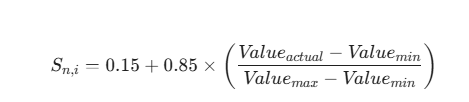
Note: If all teams achieve identical raw values, the system defaults all participants to a score of 1.0 for that specific KPI.
5. The Weighted Matrix Integration
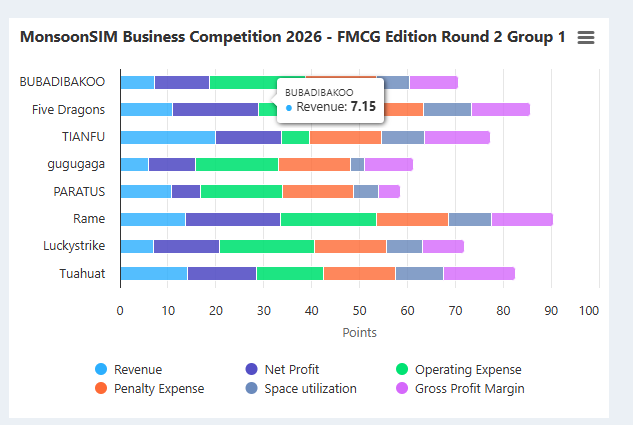
The final leaderboard position is determined by the Weighted Sum of all ten normalized KPIs. Each simulation configuration assigns a specific weight percentage to each KPI, totaling 100%.
Sample Scoring Matrix Configuration:
6. Industry Standard Alignment
The MonsoonSIM Unity Normalized Scheme is built upon the same mathematical foundations used by leading global institutions:
United Nations (Human Development Index): Uses 0–1 normalization to compare disparate metrics like life expectancy and GNI per capita.
S&P Global & Bloomberg Indices: Utilize min-max scaling to rank companies of different sizes within ESG and financial performance indices.
Balanced Scorecard Institute (BSI): Mirrors the professional requirement to balance financial health with operational efficiency and customer satisfaction.
Relative Performance Evaluation (RPE): This is the industry standard used by institutional investors to assess "Alpha"—the ability of a management team to outperform its peer group regardless of broader market trends.